October 20, 2026
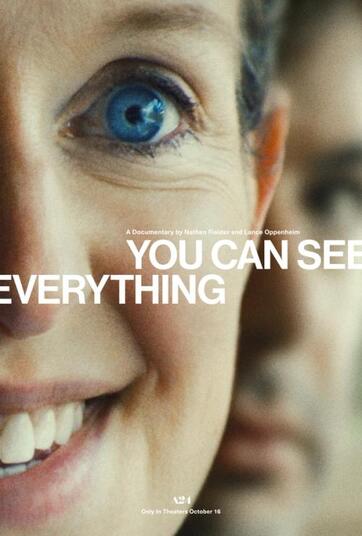
FILM: YOU CAN SEE EVERYTHING
DIRECTED BY: NATHAN FIELDER, LANCE OPPENHEIM
FEATURING: NATHAN FIELDER, ELIZABETH HOLMES, AMANAD SEYFRIED
RATING: 4 out of 4 stars
By Dan Pal
This film premiered as a secret screening at the Telluride Film Festival last month. Since then it has received rave reviews as one of the best of the year AND, having earned over $15 million in its first weekend of release, becomes the biggest non-music documentary in over 20 years. Having just seen it myself, I support its success! It is one of the most ground-breaking and original documentaries ever. The subject is Elizabeth Holmes – you know, the woman who created the Theranos company which claimed to have developed a device which could examine blood for a myriad of diseases. Holmes was tried and eventually sent to prison for lying about the results. Amanda Seyfried won an Emmy for playing her in the Hulu mini-series The Dropout. Now comes film and TV creator Nathan Fielder who was given access to Holmes in the months before her incarceration. The time he spends with her is revelatory and intimate leading to a series of questions about whether Holmes was a habitual liar or largely misunderstood. It also exposes the processed behind documentary and bio-pic filmmaking.
The early scenes of You Can See Everything establish the chief figures in this story. Holmes comes across as naïve and always smiling. She proclaims to have never lied about anything. Fielder is featured throughout the film as himself, but highly suspicious of Holmes and her man Billy. There’s something about Billy that comes across as creepy and an overly controlling figure in Holmes’s life. Fielder becomes part of the couples’ day to day existence by filming their every move and giving them a chance to tell their side of the story.
Habitually, as a former college film professor, I’m always evaluating the “truth” of a documentary based on how much work appears to have been done to establish specific shots for any “real” scene. My eyes are constantly looking at and guessing where cameras are located throughout a shoot. When I see close-ups following wide shots of a room I’m always paying attention to how logical such set ups are. Fictional films, by contrast, are typically shot again and again from different angles. If there are too many camera set-ups in a documentary I’m concerned that what I’m seeing is much too fabricated compared to a raw shooting, for instance, of an actual discussion. In the case of this film, there are several scenes which clarify where cameras are located. We even see shots of the cameras shooting the various goings on in the home. This is, after all, an attempt to film Holmes in her everyday surroundings before she does her time. She and Billy know cameras are on them and at times the crew is acknowledged. All of this makes me feel that Fielder did, in fact, shoot the film with legitimacy leaving little doubt that viewers are seeing the truth as Fielder saw it.
One can divide the documentary into three acts: Fielder’s interviews with Holmes, the initial period when she goes to prison, and where things stand two years later. There are so many twists and surprises during the last act that I don’t want to spoil as it would be giving away some of the great joys of watching the film for the first time. Suffice to say, there are some jaw-dropping moments and industry people involved that take the story in a direction which peers into the world of documentary filmmaking and begins asking a series of questions. For instance, what is the responsibility of a filmmaker to tell the truth? Because many people only know Holmes through the Seyfried mini-series does this cloud their perception of who Holmes truly is? Does interviewing provide the ultimate truth or can it be manipulated by one or both parties involved? Who should profit off stories about people’s lives? What happens when you can’t film someone in an inaccessible location such as a prison? Are re-enactments ethical and true representations of reality? These questions take the documentary into a territory which asks the industry to reflect on itself and also the audience to question what they see.
Because this is a film featuring a lot of one-on-one discussions, what is being said and how it is being said make it particularly compelling. However, given Fielder’s general easy-going and relatable personality, it is he who makes us care most about the entire process of making a film about Holmes. He wants truth. He tries calling her and Billy out on a few things. Yet, he never comes across as harsh or aggressive. He’s low-key, funny, and generally entertaining to watch even in the more dramatic moments of the film.
Does the film change how we feel about Holmes? Maybe or maybe not. We certainly get a bigger picture of her life, particularly with her partner Billy. Viewers may be surprised by some of their perspectives and even have a laugh or two at what Fielder shows them.
You Can See Everything is the kind of documentary that often gets missed by its branch of the industry during awards season. It is less straight forward and more daring than most other portraits of significant subjects. However, since it played at Telluride, it has received a rapturous response from not only the rest of the industry but fans alike. Don’t be surprised to see this potentially being the first documentary ever to be in the running for the Best Picture Oscar. It’s that good.
You Can See Everything is currently playing in theaters.