September 18, 2025
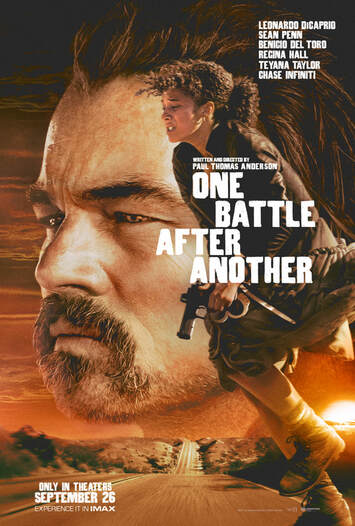
FILM: ONE BATTLE AFTER ANOTHER
DIRECTED BY: PAUL THOMAS ANDERSON
STARRING: LEONARDO DICAPRIO, SEAN PENN, TEYANA TAYLOR
RATING: 4 out of 4 stars
By Dan Pal
Let’s get this out of the way first: I’m a huge fan of Paul Thomas Anderson. I taught a course on his films about a decade ago and still find his work interesting, original, and endlessly satisfying. His latest, One Battle After Another, does not fail to live up to those expectations and more. This will, and should be, a major Oscar contender.
It begins a bit uncharacteristically for Anderson as an action thriller with Leonardo DiCaprio as Bob Ferguson, a member of a revolutionary group called French 75 that is fighting for immigrants on the U.S./Mexico border. One great aspect of Anderson’s writing and directing is that he never chooses to fall for film conventions. Even his attempt at a romantic comedy, 2002’s excellent Punch Drunk Love, which is filled with strange sounds and color bars, suggests that he does not adhere strictly to genre rules. In this latest film, the opening action sequences are also filled with some highly suggestive sexually infused scenes which almost carry as much weight as the action in the scenes do. The physical connection between Ferguson and fellow revolutionary Perfidia (Teyana Taylor) are heated but filled with playful energy. This continues with a scene featuring Sean Penn as Steven Lockjaw, a man working on the opposing side of the border revolution who is forced to walk around with a hard on as perhaps some sort of sexual game. What’s also startling about these scenes is how funny they become, setting the overall tone for the film.
There is then a time jump of about fifteen years in which not only have the characters aged but their focuses have shifted. Ferguson has become the single parent of a daughter, Willa, played by Chase Infiniti. He’s become a stoner and drunk, almost a cinematic cousin of The Dude in The Big Lebowski. During one of the funniest sequences in the film, Ferguson finds himself in a desperate situation but can’t recall any of the passcodes needed to secure the safety of himself and Willa. In a clever exchange of dialogue, he fights with a phone operator who is rule bound by the codes and feels emotionally triggered by the intense language Ferguson uses. DiCaprio is hilarious in this scene as the character’s anger, anxiety, and mellowed mind coincide as he attempts to get out of his predicament.
Sean Penn is also superior, creating one of the 21st Century’s most iconic roles as Lockjaw. Like DiCaprio’s Ferguson, the character is funny without meaning to be. He’s a pretty self-serious, conservative, fighter whose main goal evolves into becoming a member of a “Christmas Adventurer’s Club.” This seems more important to him than anything. Anderson is no doubt poking fun at groups which have surface level goodness but are essentially white racist men who are determined to uphold their own white-privileged values. Penn is pumped up with bulging muscles under a tight black shirt, of which another character suggests might indicate he is a homosexual. He also sports an extreme side buzzed haircut with short bangs that Lockjaw attempts to keep just so for his big interview with the Christmas group. He also has a rather distinctive walk which further makes his character come across simultaneously as a tough guy and buffoon. Yes, these main actors’ storylines do come together more than once during the film.
This may be one of Anderson’s most politically-minded films ever. While he creates a lot of humor and action, he appears to also be addressing a number of current issues including border control, sanctuary cities, capitalism, and fascism. Yet the tone is very much in Anderson’s vein featuring clever dialogue and wildly interesting characters. Comparisons could also be made to the films of Joel and Ethan Coen, Quentin Tarantino, and this past year’s Oscar winner, Anora. It’s a powerful and fun blend of original writing, with a lot of humor, great performances, off the wall scenarios, and expert filmmaking.
The cinematography by Anderson and Michael Bauman is full of high energy, including one scene which feels like a rollercoaster ride on a hilly road in the American Southwest. While the sound design is filled with various pop and rock sounds, Jonny Greenwood has also created another highly original music score which underscores the maddening scenes as they unfold.
It will be interesting to hear what heavily politically-minded viewers might think of the characters and how they evolve by the end of the two hour and forty-one-minute film. It seems pretty clear who Anderson is really rooting for here and who I think most of the audience will cheer on. It’s hard not to deny the power of these actors creating slightly over the top but recognizable characters who have clear social/political agendas. Yet Anderson doesn’t make everything black and white. There are sides to the richly-developed characters that suggest they are also operating in some grey zone during a pretty crazy time. Anderson makes it all very entertaining, indicating that sometimes we can only laugh at the people put in charge of supposedly making the world a better place.
One Battle After Another opens September 26 at theaters everywhere.
FILM: ONE BATTLE AFTER ANOTHER
DIRECTED BY: PAUL THOMAS ANDERSON
STARRING: LEONARDO DICAPRIO, SEAN PENN, TEYANA TAYLOR
RATING: 4 out of 4 stars
By Dan Pal
Let’s get this out of the way first: I’m a huge fan of Paul Thomas Anderson. I taught a course on his films about a decade ago and still find his work interesting, original, and endlessly satisfying. His latest, One Battle After Another, does not fail to live up to those expectations and more. This will, and should be, a major Oscar contender.
It begins a bit uncharacteristically for Anderson as an action thriller with Leonardo DiCaprio as Bob Ferguson, a member of a revolutionary group called French 75 that is fighting for immigrants on the U.S./Mexico border. One great aspect of Anderson’s writing and directing is that he never chooses to fall for film conventions. Even his attempt at a romantic comedy, 2002’s excellent Punch Drunk Love, which is filled with strange sounds and color bars, suggests that he does not adhere strictly to genre rules. In this latest film, the opening action sequences are also filled with some highly suggestive sexually infused scenes which almost carry as much weight as the action in the scenes do. The physical connection between Ferguson and fellow revolutionary Perfidia (Teyana Taylor) are heated but filled with playful energy. This continues with a scene featuring Sean Penn as Steven Lockjaw, a man working on the opposing side of the border revolution who is forced to walk around with a hard on as perhaps some sort of sexual game. What’s also startling about these scenes is how funny they become, setting the overall tone for the film.
There is then a time jump of about fifteen years in which not only have the characters aged but their focuses have shifted. Ferguson has become the single parent of a daughter, Willa, played by Chase Infiniti. He’s become a stoner and drunk, almost a cinematic cousin of The Dude in The Big Lebowski. During one of the funniest sequences in the film, Ferguson finds himself in a desperate situation but can’t recall any of the passcodes needed to secure the safety of himself and Willa. In a clever exchange of dialogue, he fights with a phone operator who is rule bound by the codes and feels emotionally triggered by the intense language Ferguson uses. DiCaprio is hilarious in this scene as the character’s anger, anxiety, and mellowed mind coincide as he attempts to get out of his predicament.
Sean Penn is also superior, creating one of the 21st Century’s most iconic roles as Lockjaw. Like DiCaprio’s Ferguson, the character is funny without meaning to be. He’s a pretty self-serious, conservative, fighter whose main goal evolves into becoming a member of a “Christmas Adventurer’s Club.” This seems more important to him than anything. Anderson is no doubt poking fun at groups which have surface level goodness but are essentially white racist men who are determined to uphold their own white-privileged values. Penn is pumped up with bulging muscles under a tight black shirt, of which another character suggests might indicate he is a homosexual. He also sports an extreme side buzzed haircut with short bangs that Lockjaw attempts to keep just so for his big interview with the Christmas group. He also has a rather distinctive walk which further makes his character come across simultaneously as a tough guy and buffoon. Yes, these main actors’ storylines do come together more than once during the film.
This may be one of Anderson’s most politically-minded films ever. While he creates a lot of humor and action, he appears to also be addressing a number of current issues including border control, sanctuary cities, capitalism, and fascism. Yet the tone is very much in Anderson’s vein featuring clever dialogue and wildly interesting characters. Comparisons could also be made to the films of Joel and Ethan Coen, Quentin Tarantino, and this past year’s Oscar winner, Anora. It’s a powerful and fun blend of original writing, with a lot of humor, great performances, off the wall scenarios, and expert filmmaking.
The cinematography by Anderson and Michael Bauman is full of high energy, including one scene which feels like a rollercoaster ride on a hilly road in the American Southwest. While the sound design is filled with various pop and rock sounds, Jonny Greenwood has also created another highly original music score which underscores the maddening scenes as they unfold.
It will be interesting to hear what heavily politically-minded viewers might think of the characters and how they evolve by the end of the two hour and forty-one-minute film. It seems pretty clear who Anderson is really rooting for here and who I think most of the audience will cheer on. It’s hard not to deny the power of these actors creating slightly over the top but recognizable characters who have clear social/political agendas. Yet Anderson doesn’t make everything black and white. There are sides to the richly-developed characters that suggest they are also operating in some grey zone during a pretty crazy time. Anderson makes it all very entertaining, indicating that sometimes we can only laugh at the people put in charge of supposedly making the world a better place.
One Battle After Another opens September 26 at theaters everywhere.