March 13, 2026
FILM: POMPEI: BELOW THE CLOUDS
DIRECTED BY: GIANFRANCO ROSI
RATING: 3 out of 4 stars
By Dan Pal
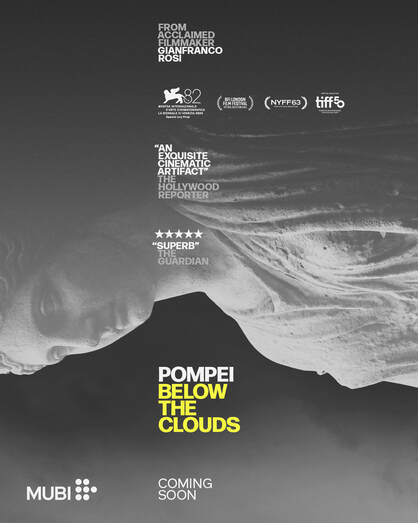
One of the great tragedies of human history was the eruption of Mount Vesuvius in 79 AD when Pompei and all its residents were buried under volcanic ash. The new documentary Pompei: Below the Clouds takes a different look at the region around Pompei as it is today. With Vesuvius still lurking nearby, signs of life from the past are found everywhere while people go about their everyday lives. Director Gianfranco Rosi’s film is beautiful to look at, shot in black and white, while also filled with a collage of images that are at times historical, mundane, and perplexing.
Like a lot of documentaries today, Pompei: Below the Clouds doesn’t feature some of the traditional elements of the genre such as a clear narrative arc, running commentary, or interviews. Instead Rosi (previously Oscar-nominated for the film Fire at Sea) gives us, in part, Hollywood’s representation of Pompei in movies being screened at an abandoned theater. This is one of the early signs illustrating the many layers of the past which are present in Pompei and the larger municipality of Naples, Italy, today. The film shows excavators continuing to find relics underground. We also see the many bodies that are encased in centuries old ash, their expressions remaining frozen in time from the moment they realized there was no escape from the horrific lava that entrapped them. Much of this is available for tourists to see, who are also shown wandering around with guides, as I once did several years ago. It’s pretty shocking and awe-inspiring to witness such found history. Rosi also shows us the excavators who continue to uncover and clean what has long been buried. At one point, we enter tunnels which have been used by tomb raiders to locate relics for their own profit.
However, there is a lot more to the region than the remnants of the 79 AD eruption which broadens what Rosi is attempting to show us. Scenes such as those in the movie theater suggest that there are more contemporary elements of the area’s history that are further waiting to be found and preserved. One archaeologist walks through a spooky-looking underground museum filled with mounds of complete statues, concrete heads, arms, and legs. The amount that is present and seemingly uncategorized is mind-boggling. So much of it and the various periods of the area’s history collide together in several different spaces with excavators waiting to return it to the community. Whether they want it or not is another matter.
Present day Naples is filled people who we hear are quite alarmed after a 3.5 level earthquake strikes the city. We don’t see this happening, but we do hear their many voices calling the fire department asking if they should remain indoors or if they think there will be another one. (As if the responders could have any idea what would come next.) Some are calling about domestic abuse and ill family members while we see the department trying to patiently address their issues.
Rosi also spends some time with Syrian refugees who are traveling by boat to work on various excavation projects. Some of them had previously been on duty near the frontlines in Ukraine and are awaiting their next assignment. At the same time, children are learning various languages in what appears to be a library setting. Are their parents trying to expand their knowledge about life beyond southern Italy? At one point a student asks their teacher about the book Les Miserables. The teacher says that it’s about “miserable” people in France’s history. He suggests they are miserable in the same way the young students are.
This may be the link between the images we see in the film and the point Rosi is trying to make. While we might wonder why we are spending so much time watching students learn and mourners mourn, perhaps Rossi is saying the destruction and emotional upheavals of the past are still very much a reality for the region’s people today. While we might be horrified by seeing the remains of helpless people from two thousand years ago, Rosi seems to be suggesting that it could happen again or has happened in various forms throughout history. All of the people in Naples today still sit in the shadow of Mount Vesuvius. Is this film a record of what this generation looks like and holds important in case another tragedy strikes there?
One might wonder if all Rosi is showing is the dark side of the region. Yet there is still a lot of beauty in the natural wonder of Vesuvius and the all that has been created under its steamy clouds over the centuries. So much of this film has the look of Ansel Adams photography that we might forget that all of it could be gone in a few terrifying minutes.
Pompei: Below the Clouds opens in limited theatrical release today, including the Gene Siskel Center in Chicago. It will also premiere on the MUBI streaming platform March 27th.
FILM: POMPEI: BELOW THE CLOUDS
DIRECTED BY: GIANFRANCO ROSI
RATING: 3 out of 4 stars
By Dan Pal
One of the great tragedies of human history was the eruption of Mount Vesuvius in 79 AD when Pompei and all its residents were buried under volcanic ash. The new documentary Pompei: Below the Clouds takes a different look at the region around Pompei as it is today. With Vesuvius still lurking nearby, signs of life from the past are found everywhere while people go about their everyday lives. Director Gianfranco Rosi’s film is beautiful to look at, shot in black and white, while also filled with a collage of images that are at times historical, mundane, and perplexing.
Like a lot of documentaries today, Pompei: Below the Clouds doesn’t feature some of the traditional elements of the genre such as a clear narrative arc, running commentary, or interviews. Instead Rosi (previously Oscar-nominated for the film Fire at Sea) gives us, in part, Hollywood’s representation of Pompei in movies being screened at an abandoned theater. This is one of the early signs illustrating the many layers of the past which are present in Pompei and the larger municipality of Naples, Italy, today. The film shows excavators continuing to find relics underground. We also see the many bodies that are encased in centuries old ash, their expressions remaining frozen in time from the moment they realized there was no escape from the horrific lava that entrapped them. Much of this is available for tourists to see, who are also shown wandering around with guides, as I once did several years ago. It’s pretty shocking and awe-inspiring to witness such found history. Rosi also shows us the excavators who continue to uncover and clean what has long been buried. At one point, we enter tunnels which have been used by tomb raiders to locate relics for their own profit.
However, there is a lot more to the region than the remnants of the 79 AD eruption which broadens what Rosi is attempting to show us. Scenes such as those in the movie theater suggest that there are more contemporary elements of the area’s history that are further waiting to be found and preserved. One archaeologist walks through a spooky-looking underground museum filled with mounds of complete statues, concrete heads, arms, and legs. The amount that is present and seemingly uncategorized is mind-boggling. So much of it and the various periods of the area’s history collide together in several different spaces with excavators waiting to return it to the community. Whether they want it or not is another matter.
Present day Naples is filled people who we hear are quite alarmed after a 3.5 level earthquake strikes the city. We don’t see this happening, but we do hear their many voices calling the fire department asking if they should remain indoors or if they think there will be another one. (As if the responders could have any idea what would come next.) Some are calling about domestic abuse and ill family members while we see the department trying to patiently address their issues.
Rosi also spends some time with Syrian refugees who are traveling by boat to work on various excavation projects. Some of them had previously been on duty near the frontlines in Ukraine and are awaiting their next assignment. At the same time, children are learning various languages in what appears to be a library setting. Are their parents trying to expand their knowledge about life beyond southern Italy? At one point a student asks their teacher about the book Les Miserables. The teacher says that it’s about “miserable” people in France’s history. He suggests they are miserable in the same way the young students are.
This may be the link between the images we see in the film and the point Rosi is trying to make. While we might wonder why we are spending so much time watching students learn and mourners mourn, perhaps Rossi is saying the destruction and emotional upheavals of the past are still very much a reality for the region’s people today. While we might be horrified by seeing the remains of helpless people from two thousand years ago, Rosi seems to be suggesting that it could happen again or has happened in various forms throughout history. All of the people in Naples today still sit in the shadow of Mount Vesuvius. Is this film a record of what this generation looks like and holds important in case another tragedy strikes there?
One might wonder if all Rosi is showing is the dark side of the region. Yet there is still a lot of beauty in the natural wonder of Vesuvius and the all that has been created under its steamy clouds over the centuries. So much of this film has the look of Ansel Adams photography that we might forget that all of it could be gone in a few terrifying minutes.
Pompei: Below the Clouds opens in limited theatrical release today, including the Gene Siskel Center in Chicago. It will also premiere on the MUBI streaming platform March 27th.