November 8, 2025
FILM: PETER HUJAR’S DAY
DIRECTED BY: IRA SACHS
STARRING: BEN WHISHAW, REBECCA HALL
RATING: 3 out of 4 stars
By Dan Pal
Let me say right from the start if you’re not interested in filmmaking or actors Ben Whishaw and Rebecca Hall, this film will likely not be for you. I give it three stars because I am one of those viewers/writers who, having made a few films myself, is fascinated by how certain projects come to life. This one is no exception. It is based on a recorded conversation between photographer Peter Hujar and Linda Rosenkrantz from 1974. The tapes were lost for decades before being found in 2019. Writer/director Ira Sachs brings the discussion they had to life for the first time. Every line of dialogue is taken from the tapes and the entire film takes place in one setting: Rosenkrantz’s apartment in New York City. As I discussed in my recent review of Blue Moon, I do find it interesting to see how directors manage the challenge of shooting in one setting. I tried it once with a short film I made a decade ago called Scotty and Josh Get Enlightened. You can judge for yourself if you think we made it interesting. For that is the key to talky, dialogue driven films like these. With Peter Hujar’s Day I don’t know that a general audience would get very caught up in the techniques used. Most viewers might find the film just plain dull.
The general context behind the conversation is that Rosenkrantz was interested in how people fill their days. So, she invited Hujar over to tell, in detail, everything he did in a previous day. The reason why this particular series of tapes was perhaps worthy of being adapted to film is because Hujar was a noted photographer and he does talk about the day he visited poet and writer Allen Ginsberg to shoot him for a New York Times profile. As such, there is some historical significance to that day. However, the details Hujar provides might be only somewhat interesting for average viewers. Yes, there are some references to Ginsberg’s and Hujar’s homosexuality but the general events of the day aren’t particularly compelling.
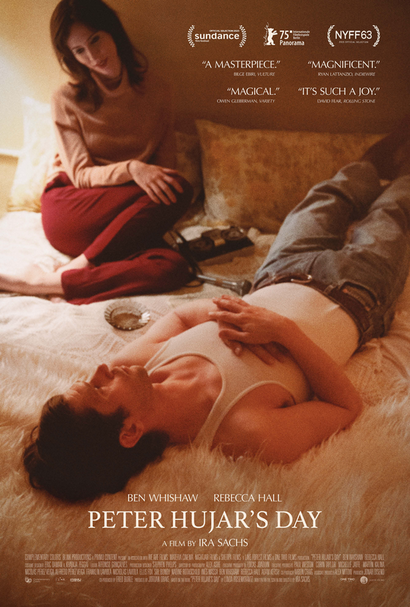
As a writer and filmmaker, I became focused on how Ira Sachs shot this conversation though. It could have really turned off audiences if the entire talk was shot with the actors sitting at a table. But Sachs uses a variety of camera angles and perspectives to make what we watch visually interesting. As it is just Wishaw and Hall in Rosenkrantz’s apartment, he directs them to move fairly often around the space. Hall, at one point, gets up to fix them some food and drink. Wishaw, as Hujar, keeps talking as she moves through the split-level apartment. In another scene, he walks towards a stereo and looks through some of her albums while he speaks. They move into her bedroom where they talk on her bed. They also go out onto a balcony while the sun sets. So, the setting is used rather expansively. Because the conversation goes on for several hours, lighting also reflects day turning into night and Sachs uses light rather effectively.
Interestingly, editing also becomes a key element to visualizing and opening up what is on the tapes. Jump cuts are used to move time ahead even if what Wishaw might be saying seems to be within the same 75-minute period of time. Did Sachs jump ahead to make the visuals more interesting? Perhaps. It also allowed him to shoot the conversation over an extended time at various points during the day. This and the fact that sometimes the actors’ clothes change suggest that the film may have been shot on different days when in fact the real conversation could have been completed over the shorter period of time. This might be confusing to some viewers but I think he uses this approach more, in part, to suggest that the dialogue between them might have had more interruptions then it appears on screen. Rosenkrantz would also have had to change the tapes periodically so there would be some break in time between each of them.
It’s important to point out that we are made aware from the first shot of the film that there is a camera crew shooting the actors. There is also an audience that applauds at the end. So, we are not supposed to believe that this is the real setting and time but a representation of it for cinematic purposes. The actors are bringing something that already exists to life and we know we are watching them do it. Strict rules of storytelling, time, and costume use are not followed traditionally. The conversation is what Sachs has decided needs to be illustrated.
Regarding Wishaw and Hall, they both have very different roles during their exchange. I should say “monologue” because this is pretty much Wishaw as Hujar talking the whole time. Hall listens…and listening she does with expert skill and patience. She gives a master class on how a listener should be giving undivided attention with brief responses and warm glances at the talker. (What some call “active” listening.) This is mostly Wishaw’s show though because he has to recreate everything said on the tapes in the manner in which Hujar does. Sadly, Hujar isn’t the most dynamic speaker as he doesn’t offer much modulation, making his “monologues” a bit tiresome to hear.
I understand that Sachs wanted to bring these tapes to life but I do question why all of what was on them was necessary to be included. It’s odd to watch such a long conversation that if we think about it, based on what we see on screen, goes on for several hours. Rosenkrantz is never asked a question or offers many great insights or her own personal reflections. By staying true to what is on the tapes and opening up the apartment setting, Sachs allows what Hujar has to say to come to life but it’s not something average viewers would have remotest interest in hearing.
I do like the concept of having people talk about what they’ve done on one day. Perhaps someone will take the idea to another level of accessibility.
Peter Hujar’s Day is currently playing in New York and L.A. It will open at the Gene Siskel Center in Chicago on November 14th.
FILM: PETER HUJAR’S DAY
DIRECTED BY: IRA SACHS
STARRING: BEN WHISHAW, REBECCA HALL
RATING: 3 out of 4 stars
By Dan Pal
Let me say right from the start if you’re not interested in filmmaking or actors Ben Whishaw and Rebecca Hall, this film will likely not be for you. I give it three stars because I am one of those viewers/writers who, having made a few films myself, is fascinated by how certain projects come to life. This one is no exception. It is based on a recorded conversation between photographer Peter Hujar and Linda Rosenkrantz from 1974. The tapes were lost for decades before being found in 2019. Writer/director Ira Sachs brings the discussion they had to life for the first time. Every line of dialogue is taken from the tapes and the entire film takes place in one setting: Rosenkrantz’s apartment in New York City. As I discussed in my recent review of Blue Moon, I do find it interesting to see how directors manage the challenge of shooting in one setting. I tried it once with a short film I made a decade ago called Scotty and Josh Get Enlightened. You can judge for yourself if you think we made it interesting. For that is the key to talky, dialogue driven films like these. With Peter Hujar’s Day I don’t know that a general audience would get very caught up in the techniques used. Most viewers might find the film just plain dull.
The general context behind the conversation is that Rosenkrantz was interested in how people fill their days. So, she invited Hujar over to tell, in detail, everything he did in a previous day. The reason why this particular series of tapes was perhaps worthy of being adapted to film is because Hujar was a noted photographer and he does talk about the day he visited poet and writer Allen Ginsberg to shoot him for a New York Times profile. As such, there is some historical significance to that day. However, the details Hujar provides might be only somewhat interesting for average viewers. Yes, there are some references to Ginsberg’s and Hujar’s homosexuality but the general events of the day aren’t particularly compelling.
As a writer and filmmaker, I became focused on how Ira Sachs shot this conversation though. It could have really turned off audiences if the entire talk was shot with the actors sitting at a table. But Sachs uses a variety of camera angles and perspectives to make what we watch visually interesting. As it is just Wishaw and Hall in Rosenkrantz’s apartment, he directs them to move fairly often around the space. Hall, at one point, gets up to fix them some food and drink. Wishaw, as Hujar, keeps talking as she moves through the split-level apartment. In another scene, he walks towards a stereo and looks through some of her albums while he speaks. They move into her bedroom where they talk on her bed. They also go out onto a balcony while the sun sets. So, the setting is used rather expansively. Because the conversation goes on for several hours, lighting also reflects day turning into night and Sachs uses light rather effectively.
Interestingly, editing also becomes a key element to visualizing and opening up what is on the tapes. Jump cuts are used to move time ahead even if what Wishaw might be saying seems to be within the same 75-minute period of time. Did Sachs jump ahead to make the visuals more interesting? Perhaps. It also allowed him to shoot the conversation over an extended time at various points during the day. This and the fact that sometimes the actors’ clothes change suggest that the film may have been shot on different days when in fact the real conversation could have been completed over the shorter period of time. This might be confusing to some viewers but I think he uses this approach more, in part, to suggest that the dialogue between them might have had more interruptions then it appears on screen. Rosenkrantz would also have had to change the tapes periodically so there would be some break in time between each of them.
It’s important to point out that we are made aware from the first shot of the film that there is a camera crew shooting the actors. There is also an audience that applauds at the end. So, we are not supposed to believe that this is the real setting and time but a representation of it for cinematic purposes. The actors are bringing something that already exists to life and we know we are watching them do it. Strict rules of storytelling, time, and costume use are not followed traditionally. The conversation is what Sachs has decided needs to be illustrated.
Regarding Wishaw and Hall, they both have very different roles during their exchange. I should say “monologue” because this is pretty much Wishaw as Hujar talking the whole time. Hall listens…and listening she does with expert skill and patience. She gives a master class on how a listener should be giving undivided attention with brief responses and warm glances at the talker. (What some call “active” listening.) This is mostly Wishaw’s show though because he has to recreate everything said on the tapes in the manner in which Hujar does. Sadly, Hujar isn’t the most dynamic speaker as he doesn’t offer much modulation, making his “monologues” a bit tiresome to hear.
I understand that Sachs wanted to bring these tapes to life but I do question why all of what was on them was necessary to be included. It’s odd to watch such a long conversation that if we think about it, based on what we see on screen, goes on for several hours. Rosenkrantz is never asked a question or offers many great insights or her own personal reflections. By staying true to what is on the tapes and opening up the apartment setting, Sachs allows what Hujar has to say to come to life but it’s not something average viewers would have remotest interest in hearing.
I do like the concept of having people talk about what they’ve done on one day. Perhaps someone will take the idea to another level of accessibility.
Peter Hujar’s Day is currently playing in New York and L.A. It will open at the Gene Siskel Center in Chicago on November 14th.