November 16, 2025
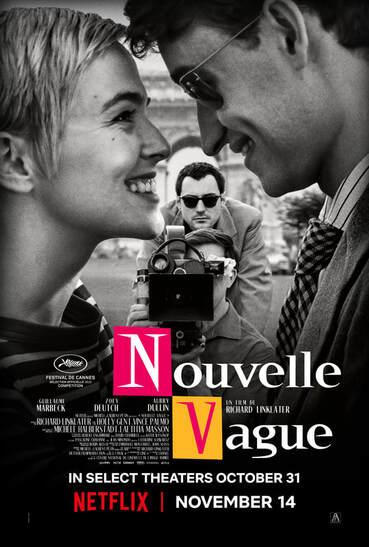
FILM: NOUVELLE VAGUE
DIRECTED BY: RICHARD LINKLATER
STARRING: GUILLAUME MARBECK, ZOEY DEUTCH, AUBRY DULLIN
RATING: 4 out of 4 stars
By Dan Pal
It’s true that one might have to know something about the French New Wave to truly appreciate this film. It was a movement in the 1950s in which wanna-be filmmakers, turned critics, turned filmmakers finally got a chance to make low-budget movies in France. The directors most associated with this movement are Francois Truffaut, Claude Chabrol, Jacques Rivette, and Jean-Luc Godard. What they did was to change the rules of filmmaking forever. By this time, traditional means of producing, shooting, lighting, editing, and so on had been firmly established in the U.S. and many other countries, including France. Working without a lot of money these directors created their own approach to storytelling that filmmakers from there on out would recognize as alternative or “guerilla” forms of movie making. Breathless, which was co-written by Godard, Truffaut, and Chabrol became a sensation when released in 1960. It would influence both Hollywood and independent filmmakers for decades to come.
Richard Linklater is one of those filmmakers who has played with the filmmaking form his whole career, including on such films as Slacker, Dazed & Confused, Tape, the Before Trilogy, Boyhood, and even the other film he released this year, Blue Moon. With Nouvelle Vague (French for “New Wave”) Linklater steps into the shoes of these filmmakers and, specifically, creates a story about the making of Breathless based on production notes, interviews, and other documented items. It is a stunning achievement. Right from the start, we dive into the world of 1950s low-budget filmmaking with Linklater’s use of grainy, black and white film. The directors mentioned above are all in a movie theater watching Truffaut’s first triumph, The 400 Blows. It becomes a sensation and motivates Godard to finally direct his own first feature.
While Guillaume Marbeck plays Godard, actors Zoey Deutch and Aubry Dullin play Jean Seberg and Jean-Paul Belmondo, respectively, who star in Breathless. With their distinctive and fashionable looks and costumes featured in the film, they both became major stars after its release. Dullin captures Belmondo’s energetic, fun-loving personality with an uncanny resemblance to the French actor. Deutch, who was born in Los Angeles, completely nails the part of Seberg, who comes across as reluctant, frustrated, and skeptical of Godard’s directorial skills. Having seen and taught Breathless in film courses for many years, there was never a moment when I didn’t think I was watching the original actors.
One of the filmmaking traits Godard (as well as other New Wave directors) was known for was breaking the glossy and precise methods of shooting a movie by using natural lighting, experimenting with camera placement and sound, and using long takes, especially of characters walking and talking (something Linklater regularly employs in his films.) Most of these techniques were done out of necessity due to budget constraints. Thus, the films looked raw, without a lot of fancy camera or editing tricks. Linklater captures all of this with his own recreation of this style of filmmaking as it relates to the making of Breathless. For instance, there are a few scenes in which he uses jump cuts (editing within a single take) which the French New Wave, especially Godard, became known for.
Linklater also illustrates how Godard captured the many unique shots used in Breathless, such as those, famously, from inside a mail cart and in the back seat of cars. He also demonstrates how Godard would make snap decisions during a filming day, including deciding to wrap after only a couple of hours (or no) shooting. He rarely allowed for coverage (alternate takes and camera angles) for most of his shots. (This could be a problem for editors who only have what’s been shot to edit a film together.) Godard’s almost amateurish approach is shown as anxiety-producing by a fraught producer of the film.
What Nouvelle Vague demonstrates is how filmmaking can be done in its rawest form. Breathless was shot in only 20 days, certainly a model for independent filmmaking even today. Godard wasn’t interested in traditional methods of making movies. He wanted them to look “instantaneous” and “realistic” – something which was not common for Hollywood filmmaking in the 1950s or now, for that matter.
Every element of this film is a spot-on recreation of the New Wave approach to filmmaking. It also features a jazzy score, true-to-period costumes, sets, and cameras. Watching Nouvelle Vague might make one think it is an actual behind-the-scenes account of the making of Breathless.
I urge you to watch Godard’s Breathless and then see Linklater’s Nouvelle Vague. The more you know about the former film the better. It definitely changed the face of filmmaking for many directors and Linklater has re-created its production flawlessly.
Nouvelle Vague is now streaming on Netflix. Breathless is streaming on HBOMax.
FILM: NOUVELLE VAGUE
DIRECTED BY: RICHARD LINKLATER
STARRING: GUILLAUME MARBECK, ZOEY DEUTCH, AUBRY DULLIN
RATING: 4 out of 4 stars
By Dan Pal
It’s true that one might have to know something about the French New Wave to truly appreciate this film. It was a movement in the 1950s in which wanna-be filmmakers, turned critics, turned filmmakers finally got a chance to make low-budget movies in France. The directors most associated with this movement are Francois Truffaut, Claude Chabrol, Jacques Rivette, and Jean-Luc Godard. What they did was to change the rules of filmmaking forever. By this time, traditional means of producing, shooting, lighting, editing, and so on had been firmly established in the U.S. and many other countries, including France. Working without a lot of money these directors created their own approach to storytelling that filmmakers from there on out would recognize as alternative or “guerilla” forms of movie making. Breathless, which was co-written by Godard, Truffaut, and Chabrol became a sensation when released in 1960. It would influence both Hollywood and independent filmmakers for decades to come.
Richard Linklater is one of those filmmakers who has played with the filmmaking form his whole career, including on such films as Slacker, Dazed & Confused, Tape, the Before Trilogy, Boyhood, and even the other film he released this year, Blue Moon. With Nouvelle Vague (French for “New Wave”) Linklater steps into the shoes of these filmmakers and, specifically, creates a story about the making of Breathless based on production notes, interviews, and other documented items. It is a stunning achievement. Right from the start, we dive into the world of 1950s low-budget filmmaking with Linklater’s use of grainy, black and white film. The directors mentioned above are all in a movie theater watching Truffaut’s first triumph, The 400 Blows. It becomes a sensation and motivates Godard to finally direct his own first feature.
While Guillaume Marbeck plays Godard, actors Zoey Deutch and Aubry Dullin play Jean Seberg and Jean-Paul Belmondo, respectively, who star in Breathless. With their distinctive and fashionable looks and costumes featured in the film, they both became major stars after its release. Dullin captures Belmondo’s energetic, fun-loving personality with an uncanny resemblance to the French actor. Deutch, who was born in Los Angeles, completely nails the part of Seberg, who comes across as reluctant, frustrated, and skeptical of Godard’s directorial skills. Having seen and taught Breathless in film courses for many years, there was never a moment when I didn’t think I was watching the original actors.
One of the filmmaking traits Godard (as well as other New Wave directors) was known for was breaking the glossy and precise methods of shooting a movie by using natural lighting, experimenting with camera placement and sound, and using long takes, especially of characters walking and talking (something Linklater regularly employs in his films.) Most of these techniques were done out of necessity due to budget constraints. Thus, the films looked raw, without a lot of fancy camera or editing tricks. Linklater captures all of this with his own recreation of this style of filmmaking as it relates to the making of Breathless. For instance, there are a few scenes in which he uses jump cuts (editing within a single take) which the French New Wave, especially Godard, became known for.
Linklater also illustrates how Godard captured the many unique shots used in Breathless, such as those, famously, from inside a mail cart and in the back seat of cars. He also demonstrates how Godard would make snap decisions during a filming day, including deciding to wrap after only a couple of hours (or no) shooting. He rarely allowed for coverage (alternate takes and camera angles) for most of his shots. (This could be a problem for editors who only have what’s been shot to edit a film together.) Godard’s almost amateurish approach is shown as anxiety-producing by a fraught producer of the film.
What Nouvelle Vague demonstrates is how filmmaking can be done in its rawest form. Breathless was shot in only 20 days, certainly a model for independent filmmaking even today. Godard wasn’t interested in traditional methods of making movies. He wanted them to look “instantaneous” and “realistic” – something which was not common for Hollywood filmmaking in the 1950s or now, for that matter.
Every element of this film is a spot-on recreation of the New Wave approach to filmmaking. It also features a jazzy score, true-to-period costumes, sets, and cameras. Watching Nouvelle Vague might make one think it is an actual behind-the-scenes account of the making of Breathless.
I urge you to watch Godard’s Breathless and then see Linklater’s Nouvelle Vague. The more you know about the former film the better. It definitely changed the face of filmmaking for many directors and Linklater has re-created its production flawlessly.
Nouvelle Vague is now streaming on Netflix. Breathless is streaming on HBOMax.