October 17, 2026
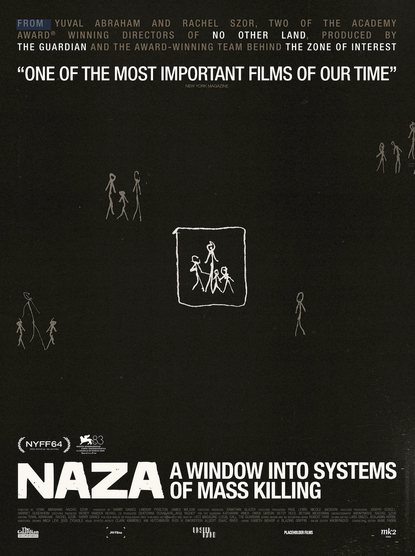
FILM: NAZA
WRITTEN & DIRECTED BY YUVAL ABRAHAM & RACHEL SZOR
RATING: 4 out of 4 stars
By Dan Pal
Two years ago, filmmakers Yuval Abraham and Rachel Szor won Oscars for the powerful documentary No Other Land which centered on the destruction of the West Bank and the bond that developed between journalists/activists Abraham and Basel Adra. The former is from Israel, the latter from Palestine. This time Abraham and Szor take a very different approach with what has happened in the region. They interview 24 people who were involved with the bombings in Gaza. With identities digitally hidden, the filmmakers are able to get detailed accounts of just how these attacks were carried out which have subsequently wiped out most of Gaza City. Their stories and perspectives are jaw-dropping to hear making this one of the most important documents to come out of a horrifying situation which still continues.
The interviews took place in Tel Aviv in 2023 on city rooftops. Abraham is in view but his subjects are not. Beyond them we see the high structures which dot the very modern city skyline. Because most of the film is focused on these interviews, the shots of the various apartments and homes within these buildings serve as a backdrop. More importantly, they represent everyday people going about their private business in their homes. We see TVs on in many of them watching the news. (It’s eerily similar to the private lives we see through windows in Alfred Hitchcock’s classic Rear Window.) There is a calmness to their lives that stands in sharp contrast to everything the interviewees are telling Abraham. Few details of their actions are spared.
We learn that their missions were to kill targets in northern Gaza in retaliation for bombing Israel and taking many of its citizens hostage. As such, the perspective of those involved in the massacre proclaim that “there are no innocent people in Gaza.” Apparently, all of Palestine is to blame even those that had nothing to do with that initial attack. The term “Naza,” we find out, means collateral damage. Specifically, it is the number of civilians who will die from a strike on a city’s buildings. Those executing such strikes admit they may be targeting specific individuals but that whole families end up dying because of them. Killing more than the specific targets aids in the ultimate mission to wipe out everything from Gaza so the surviving residents have nothing to return to when they attempt to do so.
A lot of their methods for finding their targets are disturbing to hear about. For instance, they discuss tapping into what is on their phones. This includes when they’ll be home, who is in the family, and in which buildings and floors they reside. Basically, they’re being spied on first. The larger implications of this should be obvious: our phones and what’s on them make us extremely vulnerable. Artificial intelligence is also part of the equation as it assists in the location finding. Of course, sometimes it gets it wrong. One of the interviewees mention that some 15% of the places that are bombed have no actual affiliation with specific targeted people. One man states that in a known case 500 people were killed for one Palestinian operative.
As interviewees talk we gain insight into their mindsets surrounding their killings. Perhaps most troubling are the comparisons they make: they’re very much like Nazi’s who committed genocide 80+ years ago. One says doing the job felt like a video game. Another said it was fun and enjoyable to strike targets. They were “destroying for the sake of destroying.” In other words, human life is not even a factor. There is no sense empathy for the loss of thousands of innocent people.
Some of the other visuals provided throughout the film include archival footage of the early development of Tel Aviv when there was nothing but sand in the area. Quickly we see how it transformed into a major metropolitan city. At the same time images show the destruction of Palestinian villages so that much of this development could occur. Later, the contrast between how Tel Aviv looks today and what remains of Gaza couldn’t be any more opposing. Some people live comfortably in high rises while others are searching for their trapped and diseased children under rubble.
Naza demonstrates how the horrors of the past can happen again. Now, of course, new technology like smart phones and drones offer even greater access to people’s personal lives and homes making them (us!) easy targets for enemies.
Naza is currently playing in limited theatrical release, including the Uprising Theater and Music Box Theater in Chicago. It is one of the frontrunners for this year’s Best Documentary Feature Oscar.