September 13, 2026
FILM: HEAD TO HEAD
WRITTEN & DIRECTED BY: GHASIDEH GOLMAKANI
STARRING: MEHRNOOSH SATARI, SAEED NADERI, EBRAHIM AZIZI
RATING: 4 out of 4 stars
By Dan Pal
With each year comes a growing number of films exploring Iranian women’s fight for their rights. One of the chief symbols of this is the head scarf or hijab that women are required to wear in public. In the excellent new film Head to Head, writer/director Ghasideh Golmakani showcases this struggle in an entirely original way, illustrating the issue with drama and, often, with a great sense of humor.
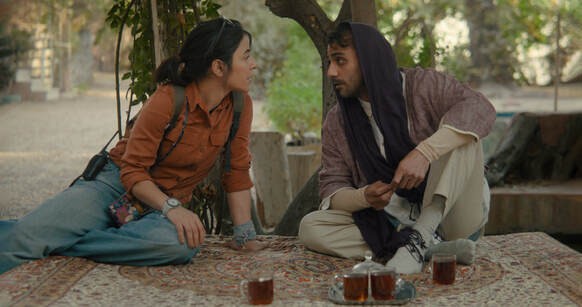
Mehrnoosh Satari plays a female director who has hired male actors to recreate scenes from famous Iranian films while dressed in oversized women’s clothes and hijabs. They’re not playing women but men with the same constraints that women must endure in the country. The initial scenes are very amusing to watch. These are masculine men, at least two of them have beards, who look like comical incarnations of men wearing women’s clothes. Of course, they struggle with their movements, the heat, and the unrelenting director, Bahar, who insists they also wear the outfits off-camera and in their private sleeping quarters.
Bahar, her assistant Saba, and cameraman Ebi are the only ones not covered up. This puts the actors in the submissive position forced to take orders from the crew. They know what they’ve signed up for but their comfort levels with the project begin to vary. One of them, Sina, is the most rebellious. He wants to further his career and dreams of being in a film that makes it to festivals. He doesn’t like the rules though, including being unable to phone his daughter. Bahar has hidden all of their phones due to the secrecy, for safety reasons, of their shooting location.
At the same time Ebi is filming them behind the scenes in what appears to be an alternative project that may be attempting to capture what the men dressed as women experience is really like on set.
There’s no question Bahar is in charge yet she must battle what a lot of directors do as she deals with the difficult Sina (very well-played by Saeed Naderi) and an unethical attempt at recording the men without their permission. Satari plays her as strong and fiercely committed to her cause. She’s equally effective in the many frustrating moments when Bahar’s project is put in danger. The moral police appear in one scene and viewers can appreciate the intensity of this moment for Bahar. Does she fight or give in to their demands?
As much a serious commentary on the long-standing cultural norms of Iranian society, Golmakani’s film also provides humorous observations about these role reversals. We see the male actors in their “female” costumes putting on long socks, trying on a feminine hat, ironing, and playing a game of soccer. It looks ridiculous, of course, and that’s the point. Why should women be subjected to such restrictive clothing? More importantly, isn’t it time for men to experience just what Iranian women must go through to leave the house? Moments like this are reminiscent of Dustin Hoffman becoming the female character Dorothy in the film 1982 film Tootsie, which provided a lot of laughs for audiences at the time. Now, decades later, Iranian men have the experience. There’s also a very funny scene in which, while on the road, Bahar is driving a van and Ebi suggests they pick up an older traditionally dressed woman who is trying to reach a toll. Once she’s in the car the woman notices the highly non-traditional role reversals with a curious, well-timed, and almost whimsical look. No dialogue is spoken but one can only imagine the thoughts inside her head. (By the way, the “toll” she is heading for ends up being a cemetery. Perhaps there was some confusion in the subtitled English translation or a brief detour in their journey.)
Golmakani is also very interested in turning her attention and dialogue towards how other directors have handled the role of women in Iranian films. She expresses her dismay that it has been mostly men who have made the films. As a result of this and the cultural requirements that keep women from dressing or moving provocatively (including not revealing their wrists) they don’t present a woman’s true perspective on screen. She also notes that women are often, unrealistically, shown wearing their hijabs inside their characters’ homes, which would be an inaccurate reflection of how they dress in their private lives.
The film is yet another highly original approach towards depicting the seemingly never-ending battle faced by women in Iran. With Head to Head, Golmakani has added even more to the conversation and a few shreds of hope.
Head to Head is premiering this week at the Toronto International Film Festival.
FILM: HEAD TO HEAD
WRITTEN & DIRECTED BY: GHASIDEH GOLMAKANI
STARRING: MEHRNOOSH SATARI, SAEED NADERI, EBRAHIM AZIZI
RATING: 4 out of 4 stars
By Dan Pal
With each year comes a growing number of films exploring Iranian women’s fight for their rights. One of the chief symbols of this is the head scarf or hijab that women are required to wear in public. In the excellent new film Head to Head, writer/director Ghasideh Golmakani showcases this struggle in an entirely original way, illustrating the issue with drama and, often, with a great sense of humor.
Mehrnoosh Satari plays a female director who has hired male actors to recreate scenes from famous Iranian films while dressed in oversized women’s clothes and hijabs. They’re not playing women but men with the same constraints that women must endure in the country. The initial scenes are very amusing to watch. These are masculine men, at least two of them have beards, who look like comical incarnations of men wearing women’s clothes. Of course, they struggle with their movements, the heat, and the unrelenting director, Bahar, who insists they also wear the outfits off-camera and in their private sleeping quarters.
Bahar, her assistant Saba, and cameraman Ebi are the only ones not covered up. This puts the actors in the submissive position forced to take orders from the crew. They know what they’ve signed up for but their comfort levels with the project begin to vary. One of them, Sina, is the most rebellious. He wants to further his career and dreams of being in a film that makes it to festivals. He doesn’t like the rules though, including being unable to phone his daughter. Bahar has hidden all of their phones due to the secrecy, for safety reasons, of their shooting location.
At the same time Ebi is filming them behind the scenes in what appears to be an alternative project that may be attempting to capture what the men dressed as women experience is really like on set.
There’s no question Bahar is in charge yet she must battle what a lot of directors do as she deals with the difficult Sina (very well-played by Saeed Naderi) and an unethical attempt at recording the men without their permission. Satari plays her as strong and fiercely committed to her cause. She’s equally effective in the many frustrating moments when Bahar’s project is put in danger. The moral police appear in one scene and viewers can appreciate the intensity of this moment for Bahar. Does she fight or give in to their demands?
As much a serious commentary on the long-standing cultural norms of Iranian society, Golmakani’s film also provides humorous observations about these role reversals. We see the male actors in their “female” costumes putting on long socks, trying on a feminine hat, ironing, and playing a game of soccer. It looks ridiculous, of course, and that’s the point. Why should women be subjected to such restrictive clothing? More importantly, isn’t it time for men to experience just what Iranian women must go through to leave the house? Moments like this are reminiscent of Dustin Hoffman becoming the female character Dorothy in the film 1982 film Tootsie, which provided a lot of laughs for audiences at the time. Now, decades later, Iranian men have the experience. There’s also a very funny scene in which, while on the road, Bahar is driving a van and Ebi suggests they pick up an older traditionally dressed woman who is trying to reach a toll. Once she’s in the car the woman notices the highly non-traditional role reversals with a curious, well-timed, and almost whimsical look. No dialogue is spoken but one can only imagine the thoughts inside her head. (By the way, the “toll” she is heading for ends up being a cemetery. Perhaps there was some confusion in the subtitled English translation or a brief detour in their journey.)
Golmakani is also very interested in turning her attention and dialogue towards how other directors have handled the role of women in Iranian films. She expresses her dismay that it has been mostly men who have made the films. As a result of this and the cultural requirements that keep women from dressing or moving provocatively (including not revealing their wrists) they don’t present a woman’s true perspective on screen. She also notes that women are often, unrealistically, shown wearing their hijabs inside their characters’ homes, which would be an inaccurate reflection of how they dress in their private lives.
The film is yet another highly original approach towards depicting the seemingly never-ending battle faced by women in Iran. With Head to Head, Golmakani has added even more to the conversation and a few shreds of hope.
Head to Head is premiering this week at the Toronto International Film Festival.