September 23, 2026
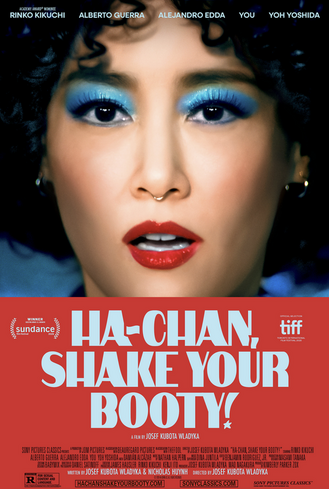
FILM: HA-CHAN, SHAKE YOUR BOOTY!
DIRECTED BY: JOSEF KUBOTA WLADYKA
WRITTEN BY: NICHOLAS HUYNH, JOSEPF KUBOTA WLADYKA
STARRING: RINKO KIKUCHI, ALEJANDRO EDDA, ALBERTO GUERRA
RATING: 3 out of 4 stars
By Dan Pal
Don’t you love the title?! It’s definitely eye-catching and also hard not to think about K.C. & the Sunshine Band (Ok, you have to be of a certain age for that reference!) or anything that is danceable and whimsical. Actually, the Sundance winning director for this film, Josef Kubota Wladyka, takes viewers to places that are dark, fantastical, and silly at times. These tonal shifts generally work but this is first and foremost a film about grief, letting go, and the power of dance and movement.
Oscar-nominated (Babel) actress Rinko Kikuchi stars as Haru, or Ha-Chan, who has a loving relationship with her husband Luis. Living in Japan, they’re dancers who are about to enter the Tokyo Dance Classic. The music is Latino-infused as Luis is originally from Mexico. A tragedy occurs though leaving Haru alone and in a state of grief for nine months. Then, two of her friends get her out of her house to “shake her booty” at a local dance studio. Almost immediately, Haru is taken with the attractive Latin teacher Fedir who was previously known for appearing on Dancing with the Stars.
The set-up of Haru and Luis’s relationship is handled well. There is clearly a strong, loving connection between them. Haru’s shift in attention to Fedir is understandable if a bit narratively sudden. Yet, it’s hard not to argue with the chemistry she feels for him. Much of this is also accentuated with periodic leaps into her fantasies that build up the connection in her mind even more. Complicating, or helping, this is Haru finding out that Fedir is himself in an open relationship. Of course, this leads to some eventual conflicts between the involved parties.
Wladyka’s film takes the material in a number of directions that do make the story interesting if somewhat familiar and thin. The fantastical elements include Haru seeing Luis in the form of a giant bird who consoles and talks to her. The costume he wears looks pretty cheap but then we’re probably not to take her fantasies too literally.
Well-done are the periodic breaks into dance numbers which never overpower the narrative but bring it to life with some skilled and fun choreography. One, in particular, is on the streets of Tokyo as Haru and Fedir dance with locals to the 1960s classic, Be My Baby. It has the kind of jovial feel of an old-time musical number or even something more recent such as the You Make My Dreams number in the film (500) Days of Summer or some of the livelier scenes in La La Land. There are also homages, via posters in Haru’s home, to films such as Punch-Drunk Love, All That Jazz, and Dirty Dancing. The last of these also gets a particularly dedicated recreation during one scene. Overall, this isn’t a musical though but alludes to the power of music and dance to help heal.
What perhaps doesn’t work as well is the sub-plot concerning whether a dead body in Japan should be cremated there vs. giving it a traditional Christian burial in its home country of Mexico. There is a bit of a resolution to this near the end but generally the conflict doesn’t really develop into anything truly necessary for the plot. Also, the jealousy which Haru feels for Fedir’s open relationship with his wife goes a bit extreme with Haru perpetually in a Day of the Dead costume and hidden under a bed. It feels like a plot device we’ve seen too often in the past.
The effectiveness of the grieving theme would likely be judged differently depending on where one is at in their own grieving process. It’s necessary to point out though that Haru’s major passion in life is dance and movement so it is only natural to her that she’d use it to heal during her own period of grief.
Rinko Kikuchi is very good as Haru, playing multi-levels that shift from love to grief and anger to infatuation. The actors playing Luis and Fedir, Alejandro Edda and Alberto Guerra respectively, move like dancers and are easy enough on the eye to see why Haru would find them so alluring.
The film doesn’t break any major ground but it does playfully move into fantasy, features lively chapter intros, and boasts a great soundtrack and some fun dance numbers. There’s definitely an audience for this one.
Ha Chan, Shake Your Booty! opens in theaters this week.
FILM: HA-CHAN, SHAKE YOUR BOOTY!
DIRECTED BY: JOSEF KUBOTA WLADYKA
WRITTEN BY: NICHOLAS HUYNH, JOSEPF KUBOTA WLADYKA
STARRING: RINKO KIKUCHI, ALEJANDRO EDDA, ALBERTO GUERRA
RATING: 3 out of 4 stars
By Dan Pal
Don’t you love the title?! It’s definitely eye-catching and also hard not to think about K.C. & the Sunshine Band (Ok, you have to be of a certain age for that reference!) or anything that is danceable and whimsical. Actually, the Sundance winning director for this film, Josef Kubota Wladyka, takes viewers to places that are dark, fantastical, and silly at times. These tonal shifts generally work but this is first and foremost a film about grief, letting go, and the power of dance and movement.
Oscar-nominated (Babel) actress Rinko Kikuchi stars as Haru, or Ha-Chan, who has a loving relationship with her husband Luis. Living in Japan, they’re dancers who are about to enter the Tokyo Dance Classic. The music is Latino-infused as Luis is originally from Mexico. A tragedy occurs though leaving Haru alone and in a state of grief for nine months. Then, two of her friends get her out of her house to “shake her booty” at a local dance studio. Almost immediately, Haru is taken with the attractive Latin teacher Fedir who was previously known for appearing on Dancing with the Stars.
The set-up of Haru and Luis’s relationship is handled well. There is clearly a strong, loving connection between them. Haru’s shift in attention to Fedir is understandable if a bit narratively sudden. Yet, it’s hard not to argue with the chemistry she feels for him. Much of this is also accentuated with periodic leaps into her fantasies that build up the connection in her mind even more. Complicating, or helping, this is Haru finding out that Fedir is himself in an open relationship. Of course, this leads to some eventual conflicts between the involved parties.
Wladyka’s film takes the material in a number of directions that do make the story interesting if somewhat familiar and thin. The fantastical elements include Haru seeing Luis in the form of a giant bird who consoles and talks to her. The costume he wears looks pretty cheap but then we’re probably not to take her fantasies too literally.
Well-done are the periodic breaks into dance numbers which never overpower the narrative but bring it to life with some skilled and fun choreography. One, in particular, is on the streets of Tokyo as Haru and Fedir dance with locals to the 1960s classic, Be My Baby. It has the kind of jovial feel of an old-time musical number or even something more recent such as the You Make My Dreams number in the film (500) Days of Summer or some of the livelier scenes in La La Land. There are also homages, via posters in Haru’s home, to films such as Punch-Drunk Love, All That Jazz, and Dirty Dancing. The last of these also gets a particularly dedicated recreation during one scene. Overall, this isn’t a musical though but alludes to the power of music and dance to help heal.
What perhaps doesn’t work as well is the sub-plot concerning whether a dead body in Japan should be cremated there vs. giving it a traditional Christian burial in its home country of Mexico. There is a bit of a resolution to this near the end but generally the conflict doesn’t really develop into anything truly necessary for the plot. Also, the jealousy which Haru feels for Fedir’s open relationship with his wife goes a bit extreme with Haru perpetually in a Day of the Dead costume and hidden under a bed. It feels like a plot device we’ve seen too often in the past.
The effectiveness of the grieving theme would likely be judged differently depending on where one is at in their own grieving process. It’s necessary to point out though that Haru’s major passion in life is dance and movement so it is only natural to her that she’d use it to heal during her own period of grief.
Rinko Kikuchi is very good as Haru, playing multi-levels that shift from love to grief and anger to infatuation. The actors playing Luis and Fedir, Alejandro Edda and Alberto Guerra respectively, move like dancers and are easy enough on the eye to see why Haru would find them so alluring.
The film doesn’t break any major ground but it does playfully move into fantasy, features lively chapter intros, and boasts a great soundtrack and some fun dance numbers. There’s definitely an audience for this one.
Ha Chan, Shake Your Booty! opens in theaters this week.