September 3, 2025
FILM: DEVO
DIRECTED BY: CHRIS SMITH
STARRING: DEVO, MARK MOTHERSBAUGH, GERALD CASALE
RATING: 3 ½ out of 4 stars
By Dan Pal
Watching the documentary Devo is like viewing what came before me, what was happening to me at a vulnerable age, and what is occurring right now in our culture. What, you say? Isn’t Devo that “weird” band that had a kooky hit with Whip It some 45 years ago? Yes... but they were so much more than that to a certain part of the culture. There’s also a bit of irony that it is the corporate world of Netflix which is making the film available for us to stream when Devo itself couldn’t have been more against commercial attention when they first started. Nevertheless, the film is a great introduction to who these guys were to a generation.
My first exposure to the band was during high school. My friend John and I would constantly talk about Saturday Night Live and one week Devo was the musical guest. Their totally original cover of the Rolling Stones’ (I Can’t Get No) Satisfaction seemed like a bizarre stunt but one that we couldn’t dismiss. After that, John would say, “that’s so Devo!” about anything that was out of the ordinary. Then we started hanging around with a new friend, Mauro, who was a year younger than us and the most unique of all our friends. With his spikey hair and penchant for wearing yellow pants, Mauro spoke to us in the same way as Devo. He had no interest in being “cool” or “traditional.” I’d go over to Mauro’s house after school and we’d listen to Devo’s albums, dance around, and play air guitar. Mauro certainly “got it” before I did but I’d forever associate the band, and what it stood for, with Mauro and John. We were all slightly off the beaten path. We weren’t the popular kids, although Mauro did win Mr. Irresistible his senior year in high school and John became a wrestler and weight lifter. However, none of us seemed to fit into the status quo of the late 70s and early 80s. While I still listened to plenty of Top 40 music when Whip It became a Top 20 hit, I thought that perhaps the world was changing and finally seeing our unique world perspectives.
What’s so interesting about the documentary Devo is that it traces the band’s roots as college students circa 1970 at Kent State. They were there when protests began against the Vietnam War, leading to the horrifying shootings of demonstrating students. Band members Mark Mothersbaugh and Gerald Casale are the most interviewed during the course of the film and they talk about how they came up with the concept of “Devo” or “De-evolution” as they saw it occurring around them. They discuss how they could see our culture being “dumbed down” and wanted to create art to reflect that. Expressing their thoughts through music came later as they combined what they called their “music, theatrics, and philosophy.”
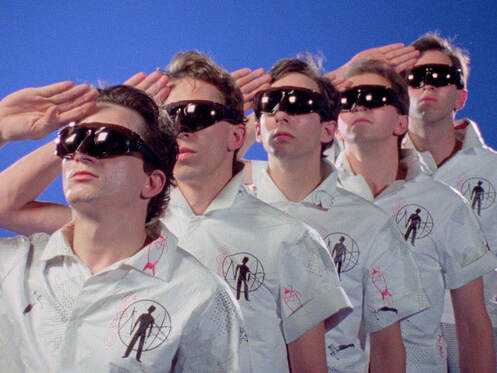
Director Chris Smith does a great job capturing the band’s visual sense and energy through a combination of their early films and live performances as well as media images including JFK, the moon landing, and various television commercials. Editing is also brisk, never relying on talking heads to tell Devo’s unique story.
Following the evolution of a band with a focus on the dangers of de-evolution could be considered a challenging task. We see how original artists like David Bowie and the Ramones would give Devo the chance to make it into the broader culture by not sacrificing their own artistic senses. Then, of course, came that famous SNL performance which brought the group to a whole other level of attention. Signing to Warner Brothers, who just wanted them to have a hit, may have been Devo’s own early “De-evolution.” Once they had Whip It on the charts, the record company wanted more. Because they were not interested in playing the corporate game, Devo struggled after that. As the documentary explores, even after MTV played the variety of films the band originally made, the network would then deem them as not having enough chart success to warrant continued play of their music videos. Yes, even something as against the grain as MTV was in the 1980s had its corporate limits.
It’s clear from the film that Devo has always been wildly misunderstood and the remaining band members acknowledge that. Whip It, and particularly its video, was a parody of American values not a show of support for it. (In much the same way Bruce Springsteen’s Born in the U.S.A. was misunderstood as a patriotic song for the Reagan era.) However, what’s great about the band, and this film, is that it is fully aware that they’ve always reflected the “disenfranchised kids” like, for a time, John, Mauro, and I were. That’s why they still have so many fans. They never succumbed to corporate greed. Granted the film doesn’t mention their 2010 reunion album and tour (which I saw in Chicago) but they do touch on Mothersbough’s great success scoring films for the last forty years and Casale’s own foray into making commercials. Everyone has to earn some kind of a living.
In spirit, though, these guys never wanted to be the “cogs in the machine” that were depicted in Fritz Lang’s 1925 classic Metropolis. Rather, in a time when, sadly, there has been a dumbing down, or perhaps “de-evolution” of our culture, these guys are an encouragement to people to not give up the fight. If the ending of Devo is a bit downbeat, then it is all the more relevant for people to wake up and be inspired by what they attempted to accomplish.
Devo is now streaming on Netflix.
FILM: DEVO
DIRECTED BY: CHRIS SMITH
STARRING: DEVO, MARK MOTHERSBAUGH, GERALD CASALE
RATING: 3 ½ out of 4 stars
By Dan Pal
Watching the documentary Devo is like viewing what came before me, what was happening to me at a vulnerable age, and what is occurring right now in our culture. What, you say? Isn’t Devo that “weird” band that had a kooky hit with Whip It some 45 years ago? Yes... but they were so much more than that to a certain part of the culture. There’s also a bit of irony that it is the corporate world of Netflix which is making the film available for us to stream when Devo itself couldn’t have been more against commercial attention when they first started. Nevertheless, the film is a great introduction to who these guys were to a generation.
My first exposure to the band was during high school. My friend John and I would constantly talk about Saturday Night Live and one week Devo was the musical guest. Their totally original cover of the Rolling Stones’ (I Can’t Get No) Satisfaction seemed like a bizarre stunt but one that we couldn’t dismiss. After that, John would say, “that’s so Devo!” about anything that was out of the ordinary. Then we started hanging around with a new friend, Mauro, who was a year younger than us and the most unique of all our friends. With his spikey hair and penchant for wearing yellow pants, Mauro spoke to us in the same way as Devo. He had no interest in being “cool” or “traditional.” I’d go over to Mauro’s house after school and we’d listen to Devo’s albums, dance around, and play air guitar. Mauro certainly “got it” before I did but I’d forever associate the band, and what it stood for, with Mauro and John. We were all slightly off the beaten path. We weren’t the popular kids, although Mauro did win Mr. Irresistible his senior year in high school and John became a wrestler and weight lifter. However, none of us seemed to fit into the status quo of the late 70s and early 80s. While I still listened to plenty of Top 40 music when Whip It became a Top 20 hit, I thought that perhaps the world was changing and finally seeing our unique world perspectives.
What’s so interesting about the documentary Devo is that it traces the band’s roots as college students circa 1970 at Kent State. They were there when protests began against the Vietnam War, leading to the horrifying shootings of demonstrating students. Band members Mark Mothersbaugh and Gerald Casale are the most interviewed during the course of the film and they talk about how they came up with the concept of “Devo” or “De-evolution” as they saw it occurring around them. They discuss how they could see our culture being “dumbed down” and wanted to create art to reflect that. Expressing their thoughts through music came later as they combined what they called their “music, theatrics, and philosophy.”
Director Chris Smith does a great job capturing the band’s visual sense and energy through a combination of their early films and live performances as well as media images including JFK, the moon landing, and various television commercials. Editing is also brisk, never relying on talking heads to tell Devo’s unique story.
Following the evolution of a band with a focus on the dangers of de-evolution could be considered a challenging task. We see how original artists like David Bowie and the Ramones would give Devo the chance to make it into the broader culture by not sacrificing their own artistic senses. Then, of course, came that famous SNL performance which brought the group to a whole other level of attention. Signing to Warner Brothers, who just wanted them to have a hit, may have been Devo’s own early “De-evolution.” Once they had Whip It on the charts, the record company wanted more. Because they were not interested in playing the corporate game, Devo struggled after that. As the documentary explores, even after MTV played the variety of films the band originally made, the network would then deem them as not having enough chart success to warrant continued play of their music videos. Yes, even something as against the grain as MTV was in the 1980s had its corporate limits.
It’s clear from the film that Devo has always been wildly misunderstood and the remaining band members acknowledge that. Whip It, and particularly its video, was a parody of American values not a show of support for it. (In much the same way Bruce Springsteen’s Born in the U.S.A. was misunderstood as a patriotic song for the Reagan era.) However, what’s great about the band, and this film, is that it is fully aware that they’ve always reflected the “disenfranchised kids” like, for a time, John, Mauro, and I were. That’s why they still have so many fans. They never succumbed to corporate greed. Granted the film doesn’t mention their 2010 reunion album and tour (which I saw in Chicago) but they do touch on Mothersbough’s great success scoring films for the last forty years and Casale’s own foray into making commercials. Everyone has to earn some kind of a living.
In spirit, though, these guys never wanted to be the “cogs in the machine” that were depicted in Fritz Lang’s 1925 classic Metropolis. Rather, in a time when, sadly, there has been a dumbing down, or perhaps “de-evolution” of our culture, these guys are an encouragement to people to not give up the fight. If the ending of Devo is a bit downbeat, then it is all the more relevant for people to wake up and be inspired by what they attempted to accomplish.
Devo is now streaming on Netflix.